
Kisspeptin is a pivotal peptide that has garnered significant attention in the realms of reproductive health and endocrinology. Produced by the KISS1 gene, kisspeptin plays a crucial role in regulating the onset of puberty and maintaining reproductive capability. Its receptor, known as GPR54 or KISS1R, is indispensable for the proper functioning of the hypothalamic-pituitary-gonadal axis, which controls the complex process of reproductive hormone release.

The discovery of kisspeptins, a family of related peptides that stem from the same gene, has opened new avenues in medical research, particularly in understanding hormonal regulation and tackling reproductive issues. Furthermore, kisspeptin’s influence on metabolism and its potential implications in cancer research have made it a subject of intense study. Investigations into the peptide’s mechanisms are helping to shape the future of therapeutic options for various conditions, including hormone-dependent cancers and infertility.
Key Takeaways
- Kisspeptin is critical in reproductive health and puberty onset.
- It acts through the GPR54 receptor to regulate hormonal pathways.
- Research on kisspeptin impacts therapeutic approaches in endocrinology and oncology.
Kisspeptin and Reproductive System
Kisspeptin plays a crucial role in regulating your reproductive system, being intimately involved in the onset of puberty, stimulating gonadotropin-releasing hormone (GnRH), and helping control your menstrual cycle and ovulation.
Role of Kisspeptin in Puberty
During puberty, your body undergoes significant changes that prepare you for sexual maturity. Kisspeptin is pivotal in triggering the onset of these changes by activating the hypothalamic-pituitary-gonadal axis. Its increase in production signals to your hypothalamus to release gonadotropin-releasing hormone (GnRH), which then stimulates the pituitary gland to produce luteinizing hormone (LH) and follicle-stimulating hormone (FSH). These reproductive hormones are key to initiating puberty.
Kisspeptin’s Impact on Gonadotropin-Releasing Hormone
Kisspeptin works closely with your hypothalamus to control the secretion of GnRH, a key hormone that regulates your reproductive health. GnRH prompts the pituitary gland to release two other hormones: luteinizing hormone (LH) and follicle-stimulating hormone (FSH). The release of these hormones is crucial for the development and function of your ovaries and testes, thus impacting your fertility.
Regulation of Menstrual Cycle and Ovulation
Your menstrual cycle is a complex interplay of hormones, and kisspeptin contributes significantly to its regulation. By influencing the release of GnRH, kisspeptin thus indirectly regulates the levels of LH and FSH in your body – hormones that are essential for the menstrual cycle. The surges in LH levels that occur due to kisspeptin’s effect can trigger ovulation, the release of an egg from the ovary, marking your body’s fertile window. Regularity in this cycle is instrumental for maintaining reproductive health and fertility.
Kisspeptin Signaling Pathways
Kisspeptin signaling is crucial for reproductive function, involving a network of neurons and receptors that interact with various peptides and proteins to regulate hormone release.
KNDY Neuron Network
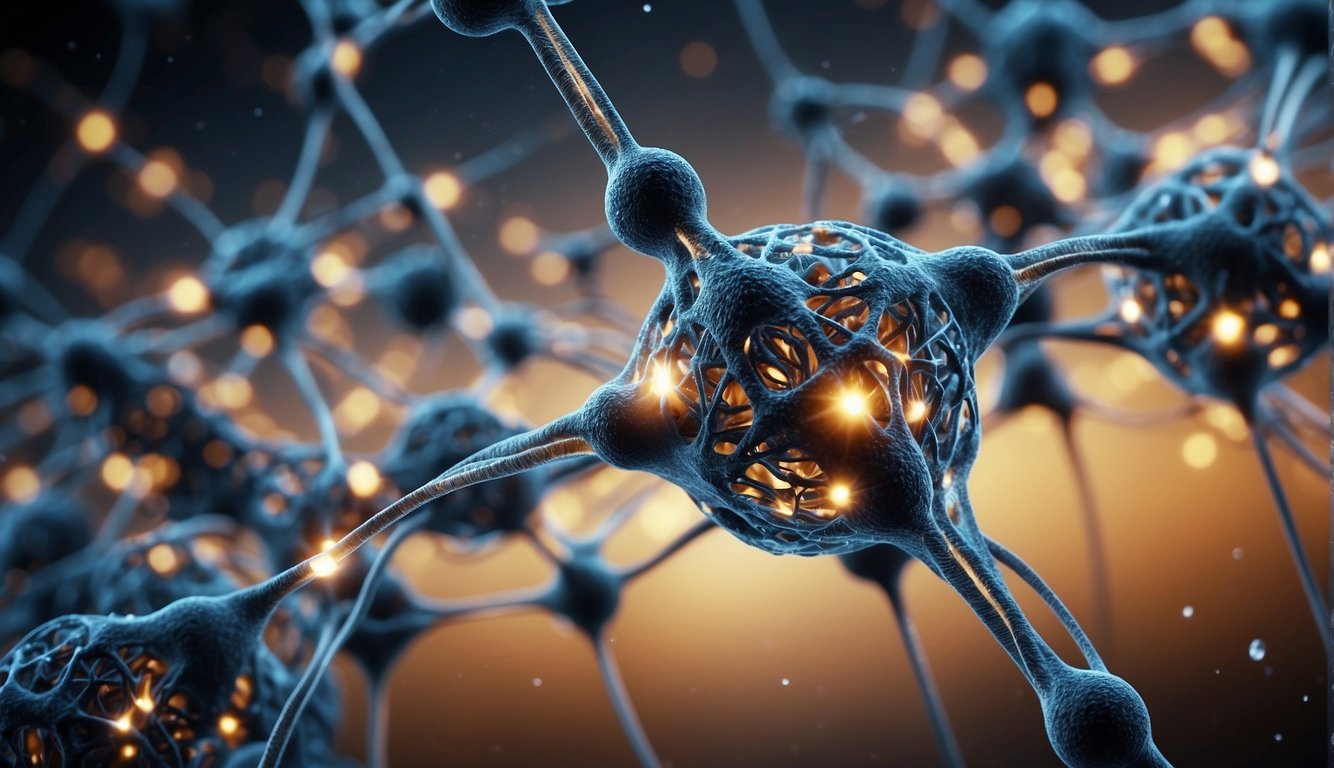
Your understanding of kisspeptin signaling pathways begins with the KNDY neuron network, consisting of neurons that co-express kisspeptin, neurokinin B (NKB), and dynorphin (a kappa opioid peptide). These neurons are located in the arcuate nucleus of the hypothalamus and play a pivotal role in the pulsatile release of gonadotropin-releasing hormone (GnRH), which is essential for reproductive function.
G Protein-Coupled Receptor Mechanism
The G protein-coupled receptor (GPCR) mechanism is central to kisspeptin signaling. Kisspeptin activates the kisspeptin receptor, also known as GPR54 or Kiss1 receptor, which is an orphan G protein-coupled receptor. Upon binding with its peptide ligand kisspeptin-10, the receptor triggers a G-protein signaling cascade that culminates in the release of GnRH.
Interaction with Neurokinin B and Dynorphin
The interplay between kisspeptin, neurokinin B, and dynorphin is intricate. NKB and kisspeptin enhance each other’s release, while dynorphin acts to inhibit this release, thus providing a feedback mechanism within the KNDY network. This delicate balance ensures the proper timing and frequency of GnRH pulses, which is critical for normal reproductive function, and has been characterized in studies involving rodents, among other species.
Using these mechanisms, kisspeptin signaling is able to modulate the reproductive axis in response to a variety of internal and external cues, underscoring its importance in maintaining reproductive health.
Clinical Implications of Kisspeptin Research

Recent advances in the study of kisspeptin have shown significant implications for treating reproductive disorders. As you explore the role of kisspeptin, you’ll find its potential in addressing diverse conditions such as hypogonadism and infertility.
Kisspeptin and Hypogonadism
Hypogonadism, a condition characterized by low sex hormone levels, can arise from disruptions in the hypothalamic-pituitary-gonadal (HPG) axis. Research has demonstrated that kisspeptin is a key regulator of this axis. Specifically, in cases of hypogonadotropic hypogonadism (low sex hormone levels due to problems with the hypothalamus or pituitary gland), kisspeptin’s role becomes even more evident. Administration of kisspeptin has been shown to stimulate the release of gonadotropin-releasing hormone (GnRH), which in turn can help in normalizing hormone levels and potentially restoring fertility.
Potential Therapeutic Uses for Kisspeptin
The therapeutic potential of kisspeptin spans a variety of reproductive issues. In women suffering from hypothalamic amenorrhea, where menstruation stops due to a problem with the hypothalamus, kisspeptin may offer new treatment pathways. Studies suggest that kisspeptin can be used to trigger ovulation, thus aiding in fertility treatment.
In the realm of polycystic ovary syndrome (PCOS) and obesity, both known to affect the reproductive axis, kisspeptin may play a therapeutic role by normalizing GnRH release and thereby improving reproductive health.
Looking at kisspeptin through the lens of libido, its influence on the reproductive axis hints at potential applications in enhancing sexual drive, which can be affected by various forms of hypogonadism.
Moreover, the research on kisspeptin also sparks hope for conditions like precocious puberty and hypogonadotrophic hypogonadism, forging a path for new, more targeted treatments that could mitigate these challenging conditions.
Kisspeptin continues to be a focal point of research, offering promise for those experiencing reproductive health challenges.
Kisspeptin’s Role in Hormonal Regulation
Kisspeptin is a critical regulator in your body’s endocrine system, particularly affecting hormones responsible for growth, sexual development, and reproduction. It directly impacts the secretion and functioning of various reproductive hormones.
Interaction with Leptin and Sex Steroids
Your body’s energy balance influences reproductive function via hormones such as leptin, which signals energy sufficiency. Kisspeptin mediates the interaction between leptin and reproduction, with leptin levels affecting Kisspeptin expression. This interaction ensures that your energy status is adequate for reproductive activities. For sex steroids, Kisspeptin neurons possess receptors for estrogen and testosterone. These hormones convey information about your gonadal status, thus influencing Kisspeptin’s regulatory role in hormonal cascades. Specifically, estradiol (a form of estrogen) positively regulates Kisspeptin expression, creating a feedback loop critical for sexual differentiation and maturation.
Influence on Gonadotropin Secretion
Kisspeptin plays a decisive role in the secretion of gonadotropins, such as luteinizing hormone (LH) and follicle-stimulating hormone (FSH). This neuropeptide stimulates the release of gonadotropin-releasing hormone (GnRH), which in turn triggers LH and FSH release, facts supported by research on Kisspeptin’s role in GnRH secretion. FSH and LH are pivotal for normal sexual development and fertility, regulating testicular and ovarian functions, including testosterone synthesis and oestradiol production. Insufficient Kisspeptin signaling has been associated with testicular degeneration and disrupted reproductive function. By modulating LH secretion, Kisspeptin plays a fundamental role in orchestrating sexual development and reproductive processes.
Endocrinology and Kisspeptin
In the intricate dance of hormones that governs reproductive function, kisspeptin plays a central role as a regulatory peptide. Your understanding of this aspect of endocrinology hinges on grasping how kisspeptin affects the hypothalamic-pituitary-gonadal (HPG) axis, particularly in relation to gonadotropin release.
Kisspeptin in Relation to the HPG Axis
Kisspeptin is intricately involved with the regulation of the HPG axis. The hypothalamus produces kisspeptin, which in turn stimulates the pituitary gland to secrete the gonadotropins: luteinizing hormone (LH) and follicle-stimulating hormone (FSH). These hormones are crucial for sexual differentiation and reproductive function. The role of kisspeptin is so pivotal that disturbances in its signaling can lead to reproductive disorders.
- Kisspeptin and Hypothalamus Interaction
- Kisspeptin is secreted by neurons in specific areas like the arcuate and anteroventral periventricular nuclei of the hypothalamus.
- It binds to its receptor, GPR54, on gonadotropin-releasing hormone (GnRH) neurons, a critical step for the onset of puberty and sustaining fertility.
Effects on FSH and LH Production
When kisspeptin interacts with its receptors, it triggers a cascade of hormonal events leading to the production of FSH and LH by the pituitary gland. These gonadotropins are vital for the function of the ovaries and testes—FSH stimulates the growth of ovarian follicles in females and spermatogenesis in males, while LH triggers ovulation and testosterone production.
-
FSH (Follicle-Stimulating Hormone)
- Essential for the growth and maturation of ovarian follicles.
- In males, supports sperm production.
-
LH (Luteinizing Hormone)
- Induces ovulation and stimulates the corpus luteum to produce progesterone in females.
- In males, prompts Leydig cells to produce testosterone.
In summary, kisspeptin’s role in the endocrine system is crucial for maintaining the functions of the HPG axis, orchestrating the synthesis and release of hormones necessary for sexual development and fertility.
Metabolic Aspects of Kisspeptin Function

Kisspeptin plays an intricate role in linking your body’s energy balance with reproductive functions, and it holds significance in regulating metabolic disorders.
Regulation of Energy Balance and Reproduction
Kisspeptin, a peptide encoded by the Kiss1 gene, is crucial for the intricate interplay between your metabolism and reproductive health. Your body’s energy status significantly influences reproductive activity through kisspeptin neurons. When your body senses sufficient energy levels, kisspeptin signals the reproductive system to function normally. Conversely, in a state of energy deficit, kisspeptin signaling may be inhibited, leading to reproductive difficulties. A noteworthy example is the presence of kisspeptin neurons affecting your metabolism and reproduction, which emphasizes how critical this balance is for overall health.
Implications for Metabolic Disorders
Researchers are exploring the potential of kisspeptin in addressing metabolic disorders like obesity. Since kisspeptin neurons have receptors sensitive to changes in your energy balance, they could be targets for therapeutic interventions. The discovery that kisspeptin signaling also influences body weight and energy expenditure expands the scope of kisspeptin beyond just reproductive regulation. By understanding the metabolic actions of kisspeptin, researchers may develop new strategies for treating conditions that stem from or lead to metabolic imbalances.
Kisspeptin and Cancer Research

Your investigation into kisspeptin’s role in cancer is crucial as it reveals the peptide’s potential as an anti-metastatic agent. With a deep understanding of its properties, you might uncover therapeutic opportunities in cancer treatment.
Insights into Metastasis Suppression
Understanding metastasis suppression is vital in cancer research as it can halt the progression of cancer. The key lies in the kisspeptin gene, often referred to as KiSS-1, which produces kisspeptin peptides such as metastin. This peptide is known to inhibit cancer cells from spreading in the body, adding a crucial layer of defense against aggressive forms of the disease. For instance, kisspeptin-54, often termed metastin, serves as a prominent figure in combating the spread of malignant melanoma, shining a light on the therapeutic potential of targeting metastasis-suppressor genes.
Relevance to Breast and Thyroid Cancer
Your research may uncover how kisspeptins play a part in the therapy for both breast cancer and thyroid cancer. The KP/KISS1R signaling pathway reveals that kisspeptins, and particularly the KISS1 gene, function as metastasis suppressors. In breast cancer, this signaling pathway can inhibit the tumor’s ability to metastasize, marking a significant step towards understanding the pathophysiology of the disease. Additionally, emerging studies suggest a noteworthy connection between kisspeptins and thyroid cancer, offering promising avenues for new therapies.
Kisspeptin in Clinical Trials and Dosage Considerations
Understanding the current landscape of kisspeptin-based therapies and their dosage considerations can directly influence treatment outcomes for fertility issues.
Current Status of Kisspeptin-based Therapies
Recent advancements in clinical trials have elucidated the potential of kisspeptin-based therapies in managing reproductive disorders. For example, a kisspeptin receptor agonist as a subcutaneous injection has shown a prolonged effect on hormone release, signaling a step forward for such treatments in both in vitro fertilization protocols and broader reproductive health issues. On the regulatory forefront, these therapies are navigating through clinical development phases and are not yet widely available. Special attention is placed on the KISS-1 metastasis suppressor, as it plays a crucial role in mitigating metastasis and could be pivotal in fertility treatments.
Safety and Efficacy in Human Subjects
Your safety is paramount when considering any clinical treatment. In terms of safety and efficacy for kisspeptin, trials have shown promising results for kisspeptin’s ability to stimulate gonadotropin secretion, which is vital for fertility. However, concerns such as ovarian hyperstimulation syndrome (OHSS), a potential risk linked with fertility treatments, and rates of miscarriage require careful monitoring of dosage. The optimization of kisspeptin dosage aims to maximize efficacy while minimizing adverse effects, but the optimal dosage to avoid fertility complications, such as infertility or OHSS, is still under investigation. Given this, you’ll find that trials are diligently determining the efficacy of kisspeptin to not only induce but also regulate essential reproductive hormones safely.
Frequently Asked Questions
When considering Kisspeptin peptides, you may have questions regarding their benefits, usage, and effects. This section aims to address frequently asked questions to provide concise insights into Kisspeptin peptides.
What are the potential benefits of using Kisspeptin peptides?
Kisspeptin peptides have been studied for their role in reproductive hormone regulation, potentially influencing testosterone levels, sexual function, and fertility.
How is Kisspeptin supplementation used?
Supplementation with Kisspeptin is typically used to boost natural reproductive hormone function, with research focusing on its potential to activate the hypothalamus and initiate hormone secretion.
What is the recommended dosage for Kisspeptin peptides?
The optimal dosage of Kisspeptin peptides can vary based on factors like age and health, and it is crucial to follow specific guidelines to avoid side effects or hormonal imbalances.
What effects does Kisspeptin have on male physiology?
In males, Kisspeptin can influence the secretion of reproductive hormones which may have effects on aspects such as testosterone levels and spermatogenesis.
In which areas of the body is Kisspeptin naturally produced?
Kisspeptin is naturally produced in the hypothalamus of the brain and plays a significant role in the regulation of the gonadotropin-releasing hormone.
Are there any known side effects associated with Kisspeptin peptide usage?
While Kisspeptin peptide usage may be associated with certain side effects, its safety profile is still under investigation. Reported side effects could involve hormonal imbalance and reactions at the injection site.